Abstract
This thesis investigates how embodied avatars and generative AI can support self-directed mathematics learning inside a virtual classroom.
The work combines short calculus videos, quizzes, speech interaction, a generative AI assistant, and an optional animated avatar in one Meta Quest 3 experience. The central question is not only whether VR feels more immersive, but whether visual embodiment changes how learners experience and evaluate AI-supported study.
A two-participant pilot informed the final interaction design, followed by a within-subject study with 18 participants. Both VR conditions produced significantly higher immersion and enjoyment than desktop video learning. The study found no statistically significant differences in comprehension, cognitive load, effort, or frustration, and no reliable rating-scale advantage of the avatar over the text-based VR assistant.
- 18
- study participants
- 3
- learning conditions
- 7
- shared experience measures
- 125
- pages in the thesis
Research framing
What the thesis asks
The study separates the effect of immersive delivery from the added effect of giving a conversational AI assistant a visible, speaking body.
Does embodiment change the AI learning experience?
How does adding an embodied avatar to a generative AI assistant affect engagement and enjoyment in a self-learning VR classroom?
How does VR compare with desktop learning?
How do VR-based conditions compare with PC video learning in immersion, enjoyment, and quiz performance?
Three contributions
- A working VR self-learning system that combines calculus videos, quizzes, voice dialogue, generative AI, and an embodied teaching avatar.
- A counterbalanced within-subject study that isolates desktop, text-based VR assistant, and embodied-avatar conditions.
- Empirical evidence that distinguishes affective benefits from learning outcomes, including the limitations of embodiment in a short educational session.
System
A complete self-learning classroom
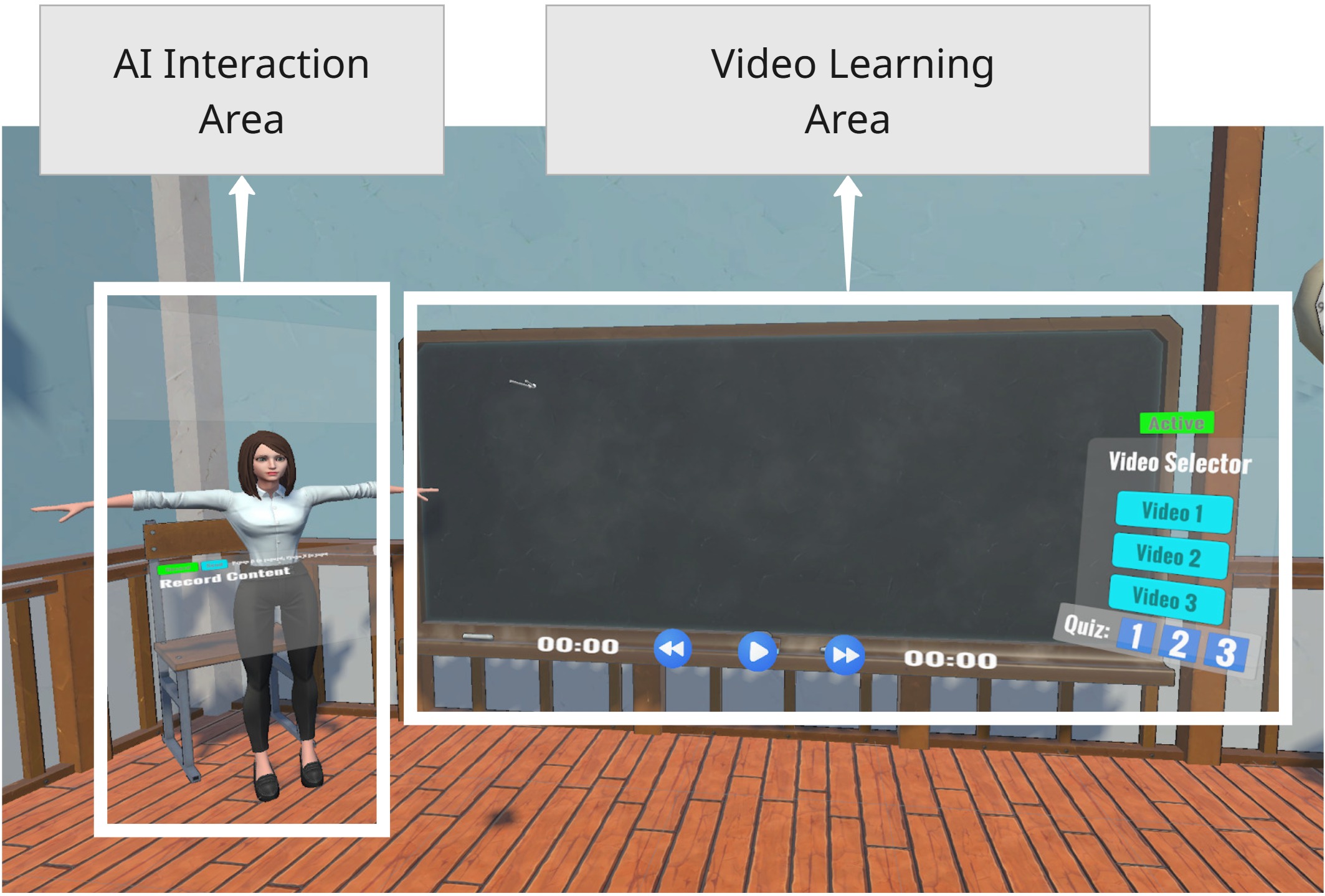
The room is divided into an AI interaction area and a video learning area so that explanation, practice, and assessment remain available within one spatial environment.
Video learning
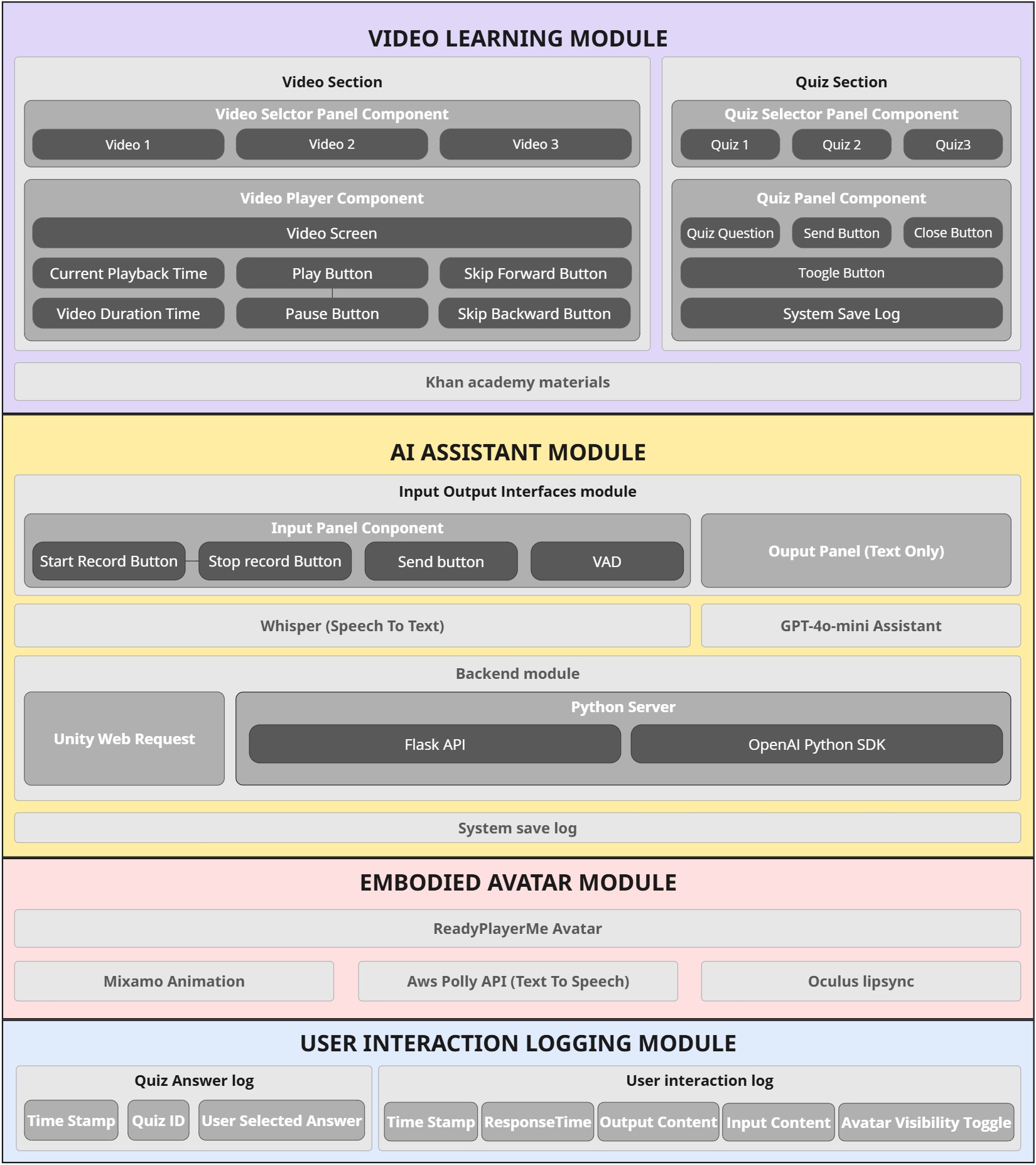
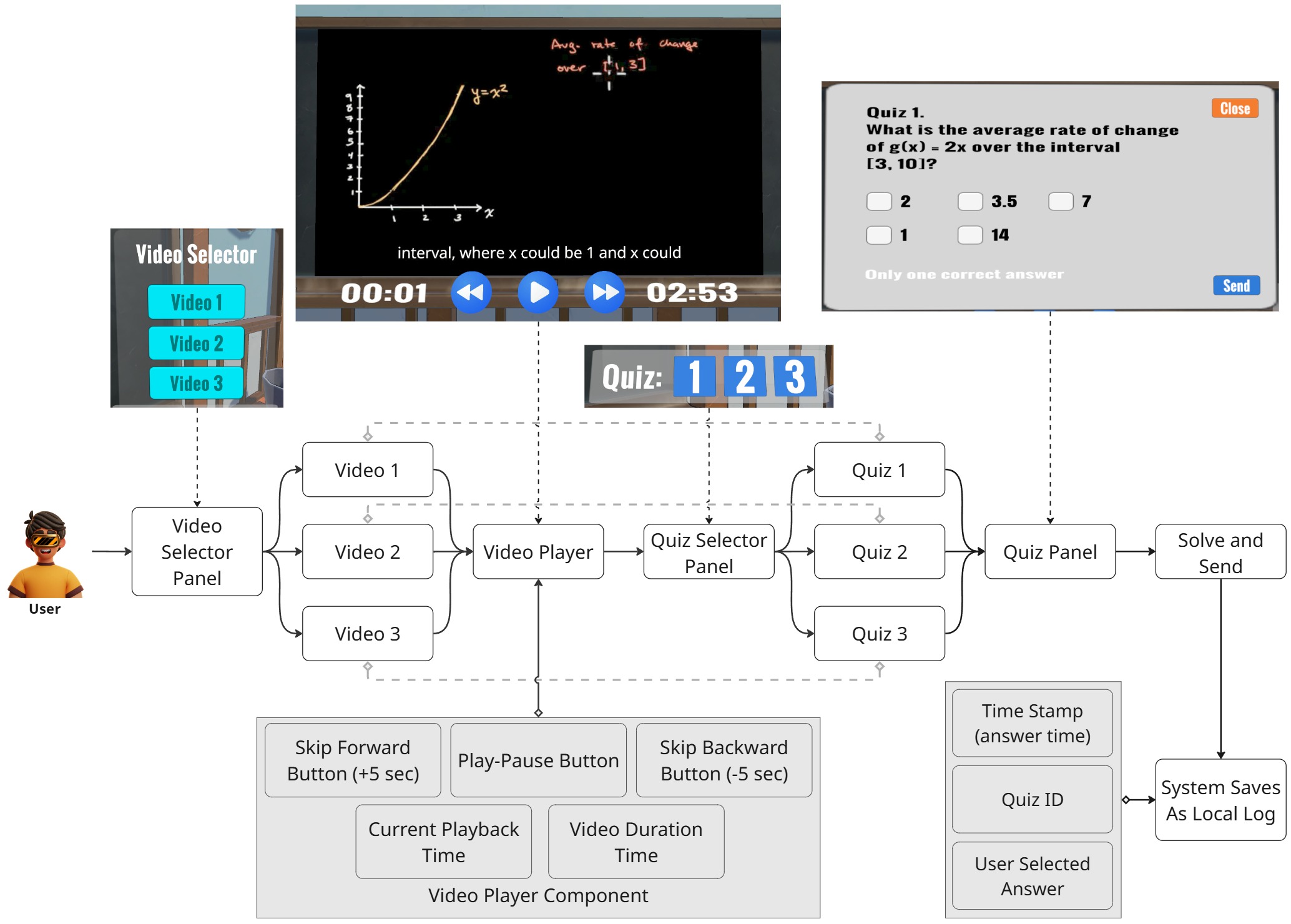
Three approximately three-minute Khan Academy derivatives videos, playback timing, play/pause, five-second skip controls, and matching quizzes.
AI assistant
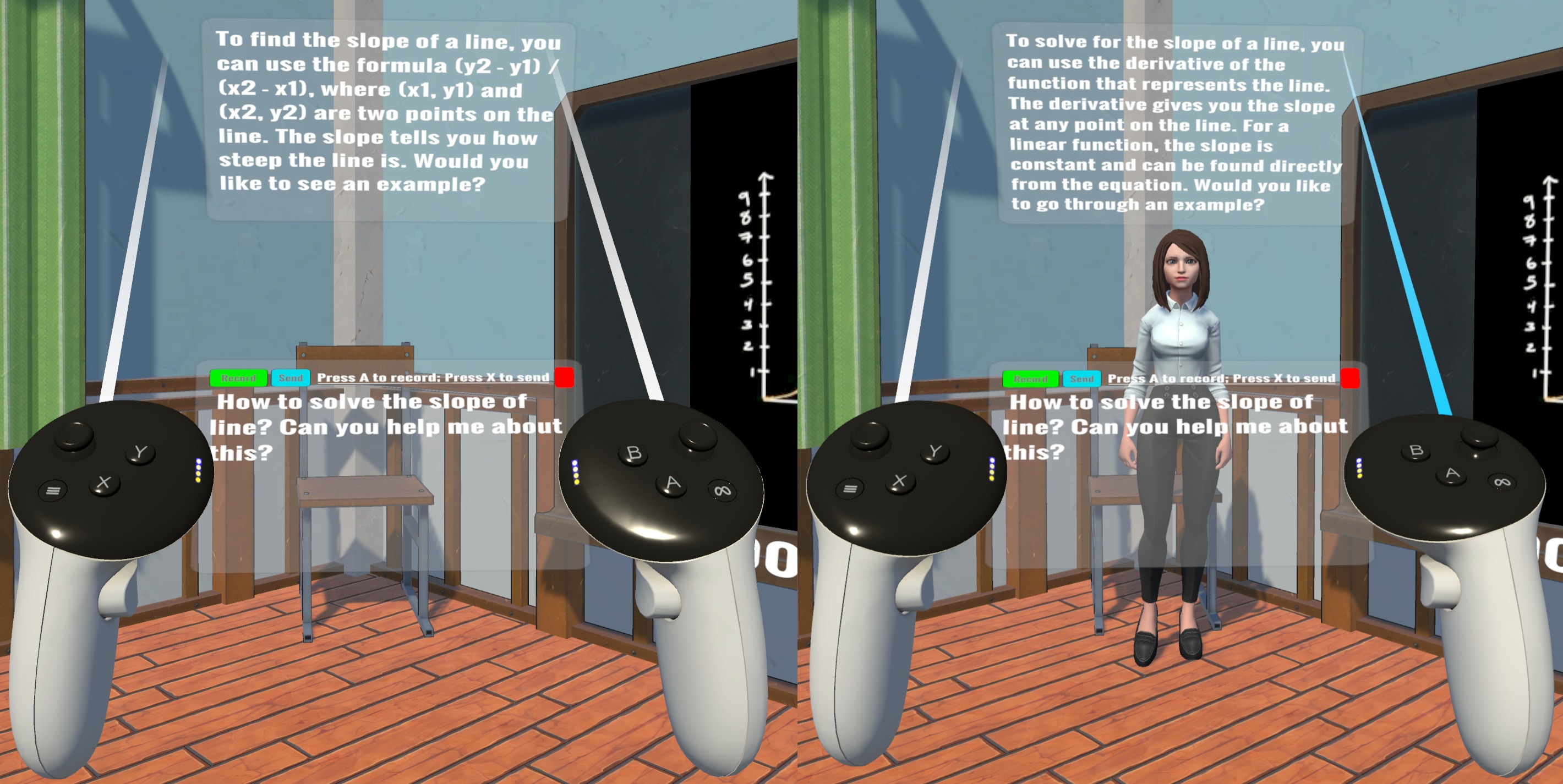
Voice input is transcribed with Whisper and sent through a local Flask backend to a GPT-4o-mini assistant grounded in the lesson transcripts and quiz material.
Embodied avatar
A Ready Player Me teacher uses Mixamo animation, Amazon Polly speech, and Oculus LipSync to present the same AI response through voice and facial motion.
Interaction logging
Local logs retain quiz answers, timestamps, questions, AI responses, response time, and avatar visibility for later analysis.
- VR application
- Unity 2022.3.62f1, URP, OpenXR
- Hardware
- Meta Quest 3 via Quest Link
- Speech input
- Whisper base.en in Unity
- AI backend
- Python 3.13, Flask, OpenAI SDK
- Response model
- GPT-4o-mini assistant
- Avatar output
- Amazon Polly, Oculus LipSync, Mixamo
Interaction design
From lesson to dialogue
The prototype supports two connected learning loops: watch and answer a quiz, or pause and ask the assistant for a spoken explanation.
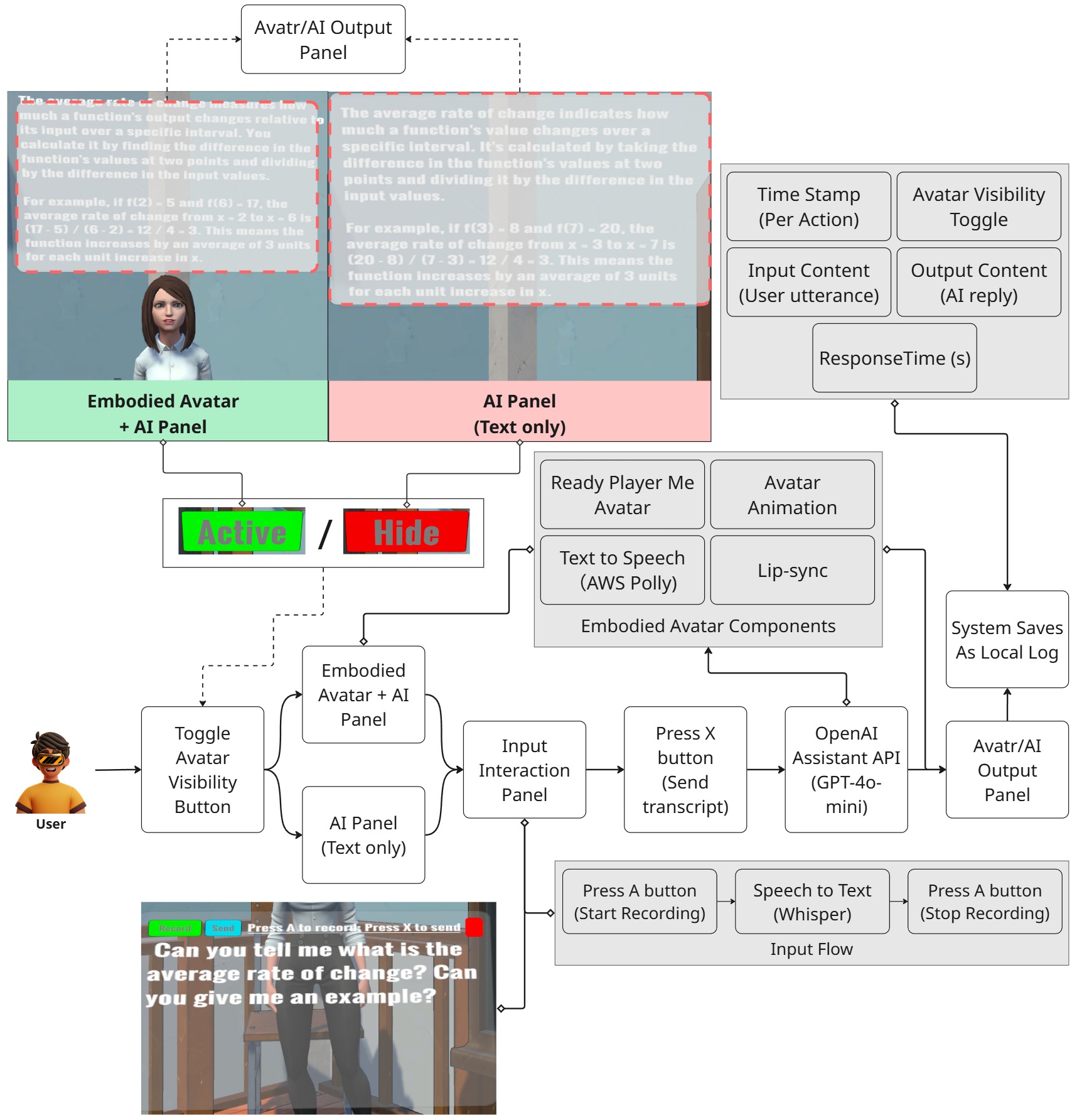
Shared dialogue core
C2 and C3 use the same speech recognition, prompt grounding, backend, and response generation. The experimental difference is how the response is presented: text only or text plus a speaking animated avatar.
Controller-first operation
The A button starts and stops recording, while the X button sends the transcript. A visual voice-activity indicator changes between idle and recording states so the learner can confirm when the system is listening.
Design iteration
The pilot changed the final system
A two-participant pilot was used as an engineering and usability checkpoint. It showed that the prototype was stable, but also exposed passive-viewing fatigue, missing navigation controls, unclear recording feedback, and AI response delays of approximately 3-5 seconds.
- Shorter lessonsVideo segments were reduced from roughly five minutes to approximately three minutes to limit fatigue and loss of attention.
- Playback controlFive-second forward and backward controls were added so learners could revisit difficult moments or skip familiar material.
- Measured latencyAI response timing was added to the logs and assistant instructions were refined, while cloud-processing delay remained an acknowledged constraint.
Evaluation
A counterbalanced three-condition study
Every participant experienced every condition. A balanced Latin square varied the condition order, reducing sequence effects without changing the fixed lesson and quiz sequence.
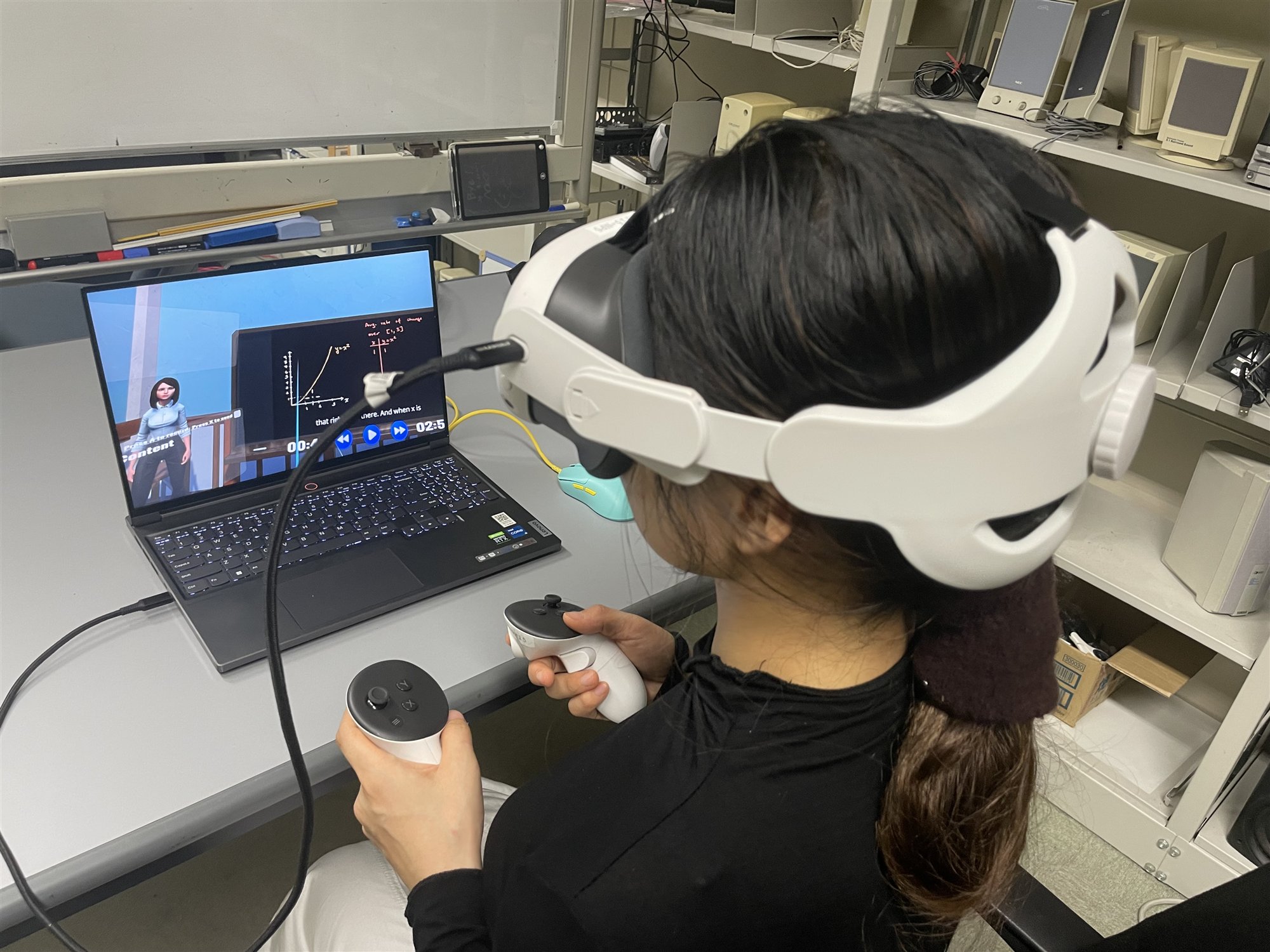
- C1 · Desktop videoComputer-based calculus video and quiz without VR or AI. Participants could use paper for notes and calculations.
- C2 · VR + text AIVR video learning with voice input and a generative AI response shown on a floating text panel.
- C3 · VR + embodied AIThe same VR and AI pipeline, with responses also spoken by a lip-synced animated teacher avatar.
Learn
Watch one fixed three-minute differential calculus video.
Ask
In C2 and C3, ask at least one lesson-related question through speech.
Answer
Complete the matching comprehension quiz for that session.
Reflect
Submit the questionnaire, then rank all three conditions at the end.
Measures
Seven shared 7-point items covered immersion, enjoyment, comprehension, mental demand, physical demand, effort, and frustration. The questionnaire adapted relevant concepts from IPQ and NASA-TLX and was presented in English, Japanese, and Chinese.
C3 added four avatar-specific ratings inspired by AttrakDiff: human-likeness, usefulness, pleasantness, and appearance. A typical full study lasted 25-45 minutes, with most participants finishing within 35 minutes.
Quantitative results
Experience improved more than performance
Cumulative link mixed models accounted for the ordinal ratings and repeated observations from each participant. Condition affected immersion and enjoyment, but not the other five shared measures.
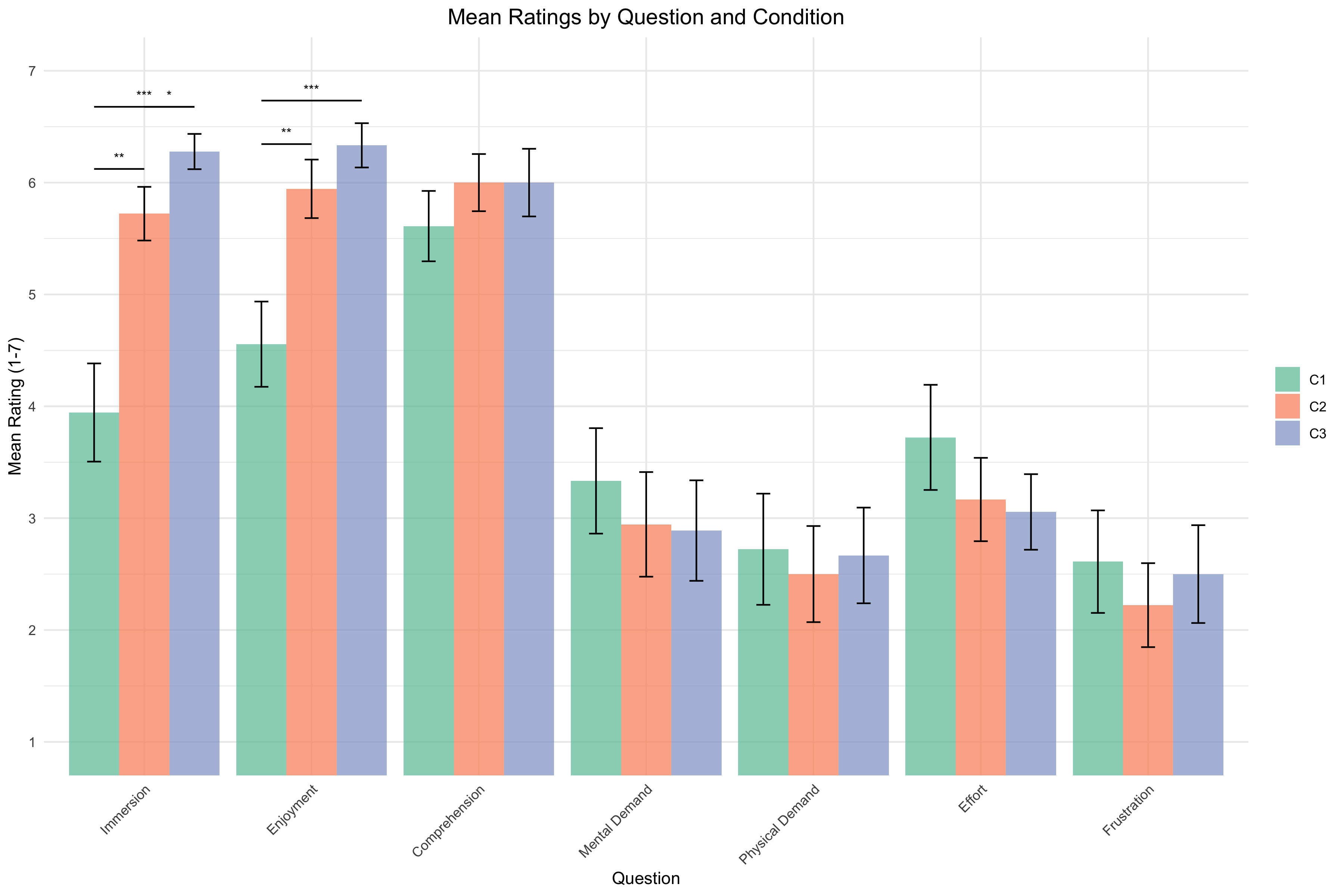
| Measure | Chi-square | p-value | Interpretation |
|---|---|---|---|
| Immersion | 18.25 | < .001 | Significant |
| Enjoyment | 14.57 | < .001 | Significant |
| Comprehension | 2.50 | .287 | No condition effect |
| Mental demand | 1.77 | .413 | No condition effect |
| Physical demand | 0.66 | .717 | No condition effect |
| Effort | 2.19 | .334 | No condition effect |
| Frustration | 0.11 | .948 | No condition effect |
C1 was lower than both VR conditions
C1 vs C2: estimate -2.64, p=.002. C1 vs C3: estimate -3.79, p<.001. C2 and C3 were not significantly different (p=.188).
The same VR advantage appeared again
C1 vs C2: estimate -2.35, p=.006. C1 vs C3: estimate -3.19, p<.001. C2 and C3 were not significantly different (p=.431).
A numerical rise, not a demonstrated gain
Mean scores were approximately 78 in C1 and 83 in C2/C3, but the thesis found no statistically significant performance difference.
Avatar perception
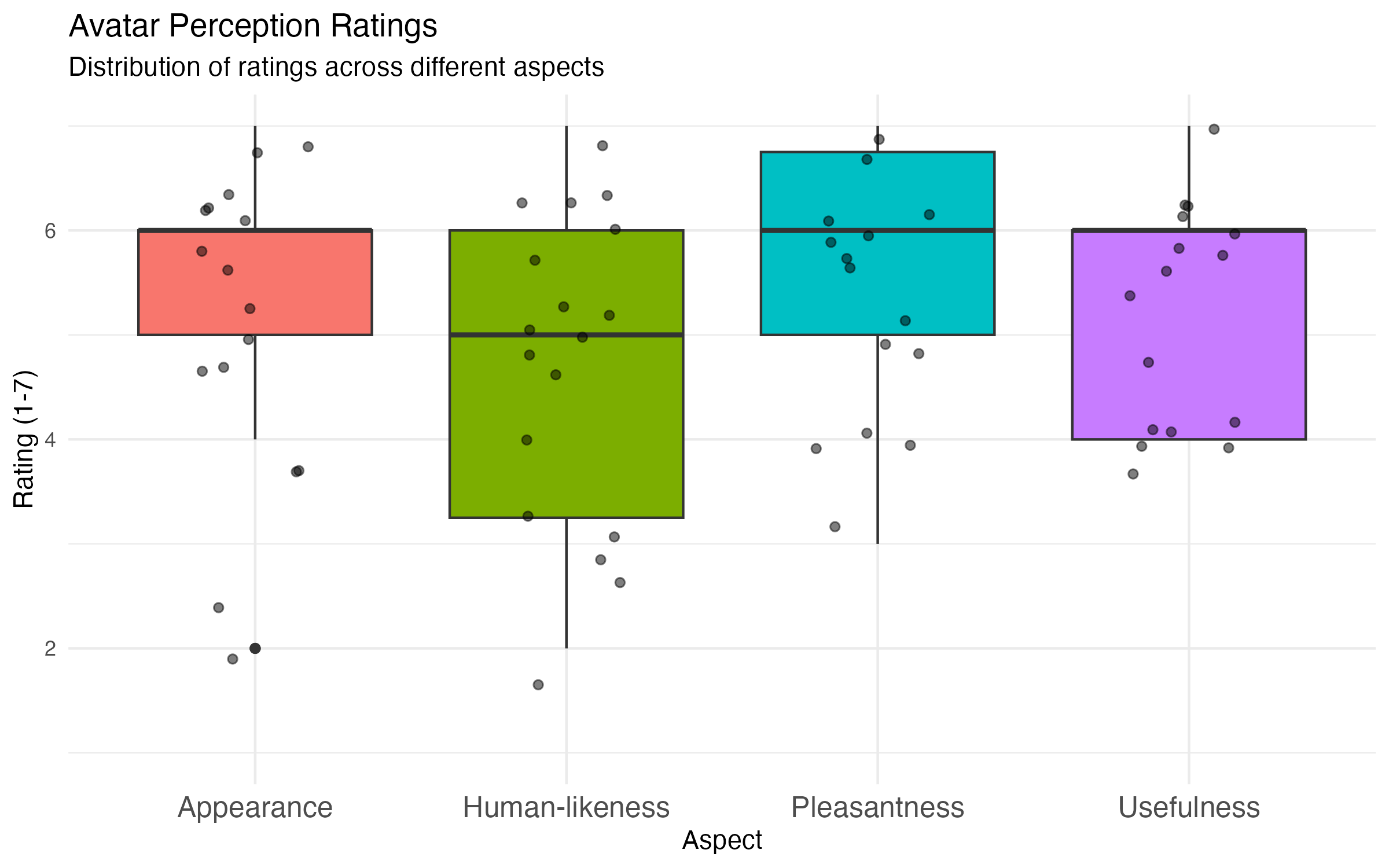
Pleasant and useful, but not fully human-like
Pleasantness had the highest median rating at approximately 6.5/7. Appearance and usefulness were both around 6, while human-likeness was lower at around 5 and varied most between participants.
Participant feedback
What the numbers did not capture
Open-ended responses explain why participants could prefer the embodied condition while the measured C2-C3 differences remained statistically inconclusive.
Presence and focus
Participants described the room as realistic and immersive; several said VR reduced outside distraction compared with desktop learning.
An empty classroom
The same environment could feel static when little was happening. Participants wanted more dynamic content, prompts, and responsive activity.
Promising but disconnected AI
The assistant was seen as potentially helpful, but it did not know which video had just played and could return generic or repetitive responses.
Language accessibility
Fast English video delivery and English-only dialogue created friction for non-native speakers, motivating multilingual speech and adjustable playback.
Avatar realism
Some learners found the avatar motivating; others wanted more human-like behavior, gaze, gestures, and proactive interaction instead of a static distant posture.
Learning tools inside VR
Participants missed the paper available in C1 and requested virtual note-taking, a scratchpad, interactive whiteboards, and more demanding adaptive quizzes.
Discussion
What this thesis establishes
The strongest contribution is a practical, end-to-end framework showing that conversational AI and embodiment can be integrated into a coherent VR learning workflow and evaluated without conflating preference with learning effectiveness.
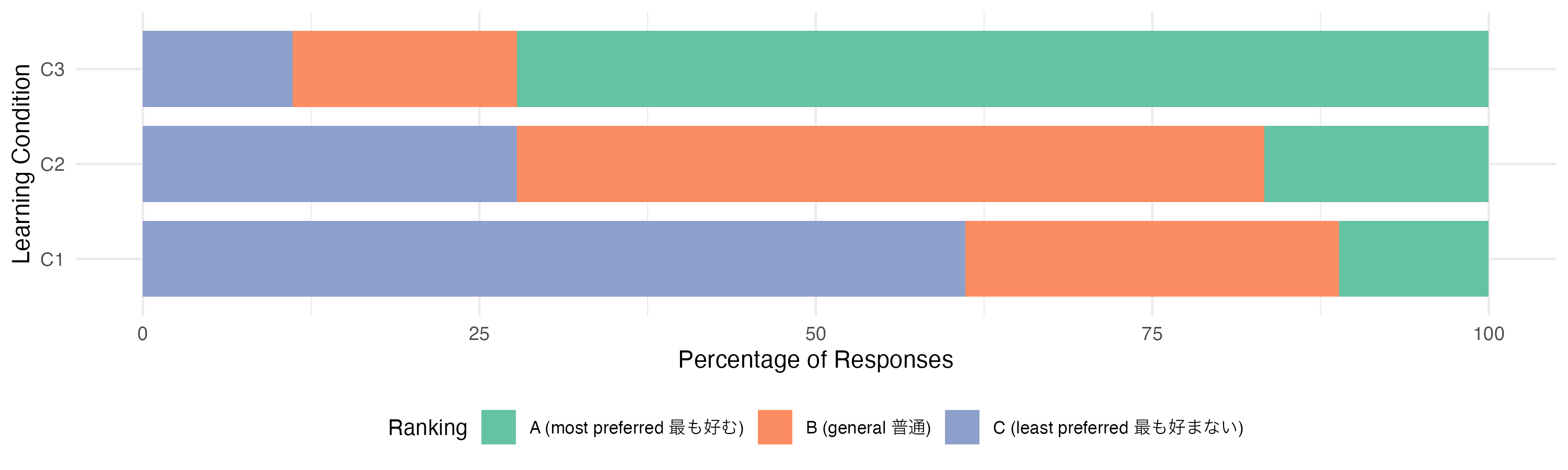
RQ1 received partial support: C3 was the most preferred condition and was rated slightly higher in enjoyment, but the measured difference between C2 and C3 was not statistically significant. RQ2 was supported for subjective experience: both VR conditions improved immersion and enjoyment relative to desktop learning, but not short-term comprehension or quiz performance.
Next research directions
- Context-aware tutoring: connect the assistant directly to the current video, quiz, and learner progress.
- Multilingual interaction: support multiple input/output languages, subtitles, and adjustable speaking speed.
- More expressive embodiment: improve gaze, gesture, affect, timing, and proactive classroom behavior.
- Active learning tools: add spatial notes, handwriting, whiteboards, scaffolding, and adaptive questions.
- Longer and broader studies: test retention, repeated use, more participants, and subjects beyond calculus.
Evidence boundary: this was a short within-subject study with 18 participants. It supports an affective and experiential benefit for VR, but not a demonstrated learning gain or a statistically reliable advantage of embodiment over the text-based VR assistant.
System constraints included delayed responses, imperfect speech recognition, English-only interaction, limited avatar behavior, and the absence of in-VR note-taking. These limitations are part of the research contribution because they identify where an embodied AI tutor must improve before longer-term educational claims are justified.