← Research archive

2025 IEEE Gaming, Entertainment, and Media Conference (GEM) · Published

VR Math Bridge: Bridging Interactivity in Online Education with AI and VR

An immersive calculus classroom that brings video lessons, a voice-first embodied AI tutor, and spatial learning analytics into one Quest 3 experience.

HuiShan Lai, Alaeddin Nassani, John Blake, Julián Villegas

University of Aizu · Aizuwakamatsu, Japan

DOI: 10.1109/GEM66882.2025.11155841

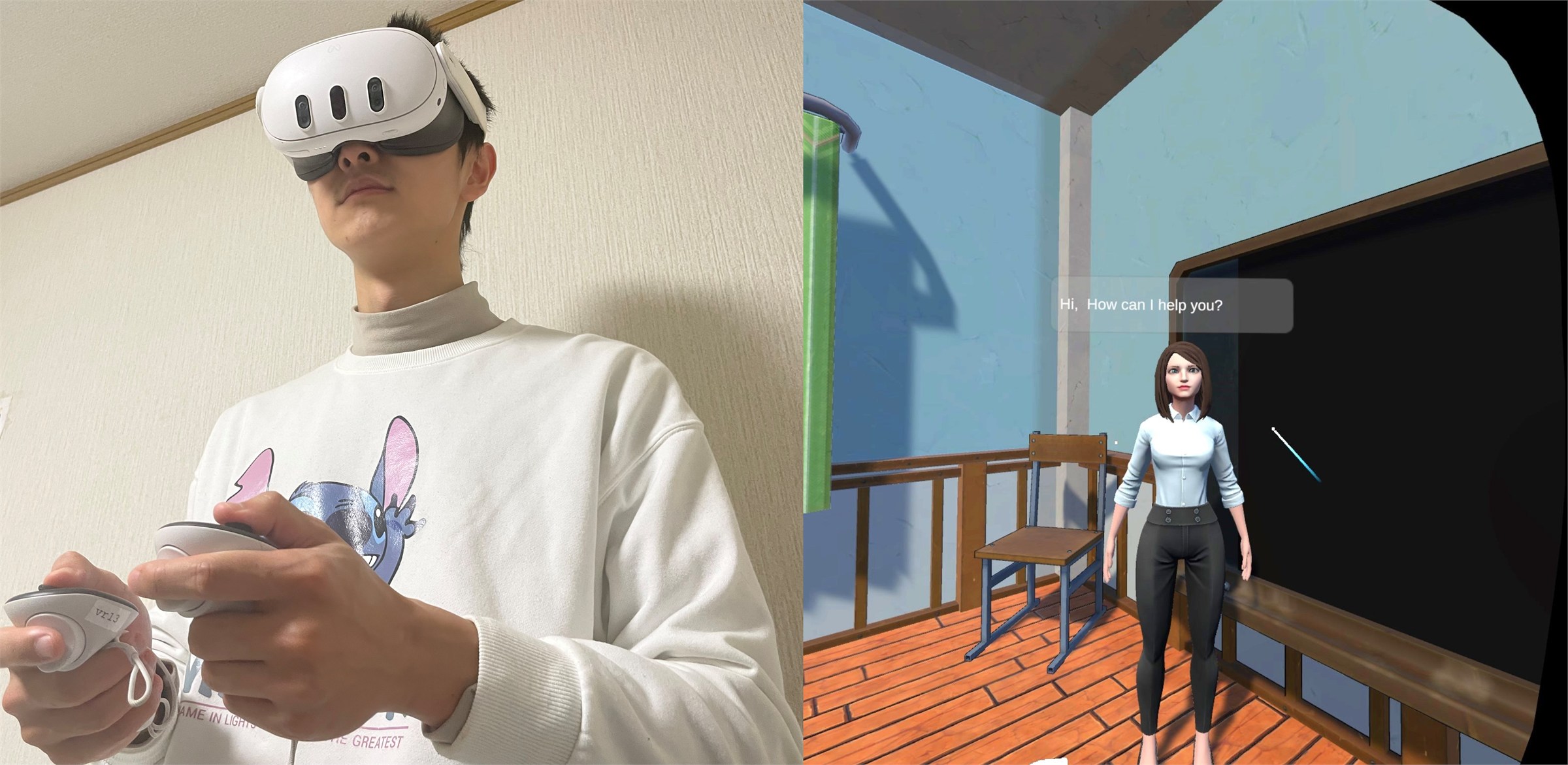
A participant wearing a Meta Quest 3 headset beside the VR classroom and embodied AI teaching assistant
VR Math Bridge prototype on Meta Quest 3, developed with Unity 2022.3.

Abstract

VR Math Bridge extends established online calculus content with an immersive classroom and an AI-driven teaching assistant that can answer questions in real time.

Students choose a chapter from a floating panel, watch Khan Academy material on a virtual blackboard, and pause to ask an embodied 3D tutor for personalized explanations. Cognitive 3D captures attention and interaction signals to help researchers understand how learners use each part of the environment.

The current Quest 3 prototype focuses on derivatives. A preliminary two-participant evaluation was used to surface usability issues and guide a larger future study; it does not establish learning effectiveness.

System

System overview

The prototype combines trusted lesson content, voice-based assistance, and spatial interaction logging in one learning flow.
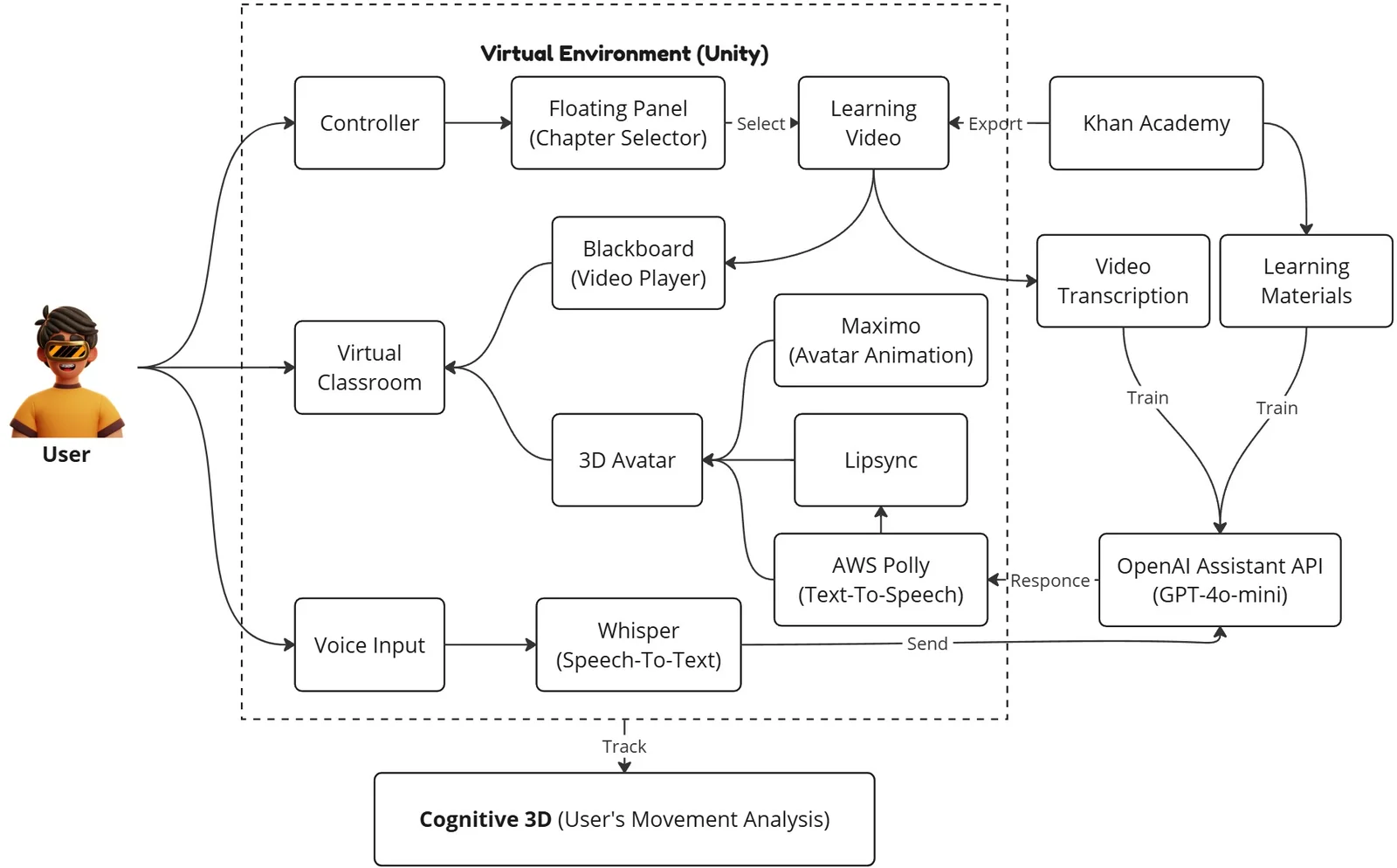
VR Math Bridge system architecture connecting the Quest controller, virtual classroom, Khan Academy content, AI assistant, speech services, avatar animation, and Cognitive 3D
Voice input is transcribed and sent to an AI assistant grounded in lesson transcripts and learning materials. The response returns through speech, lip-sync animation, and an on-screen chatbox.
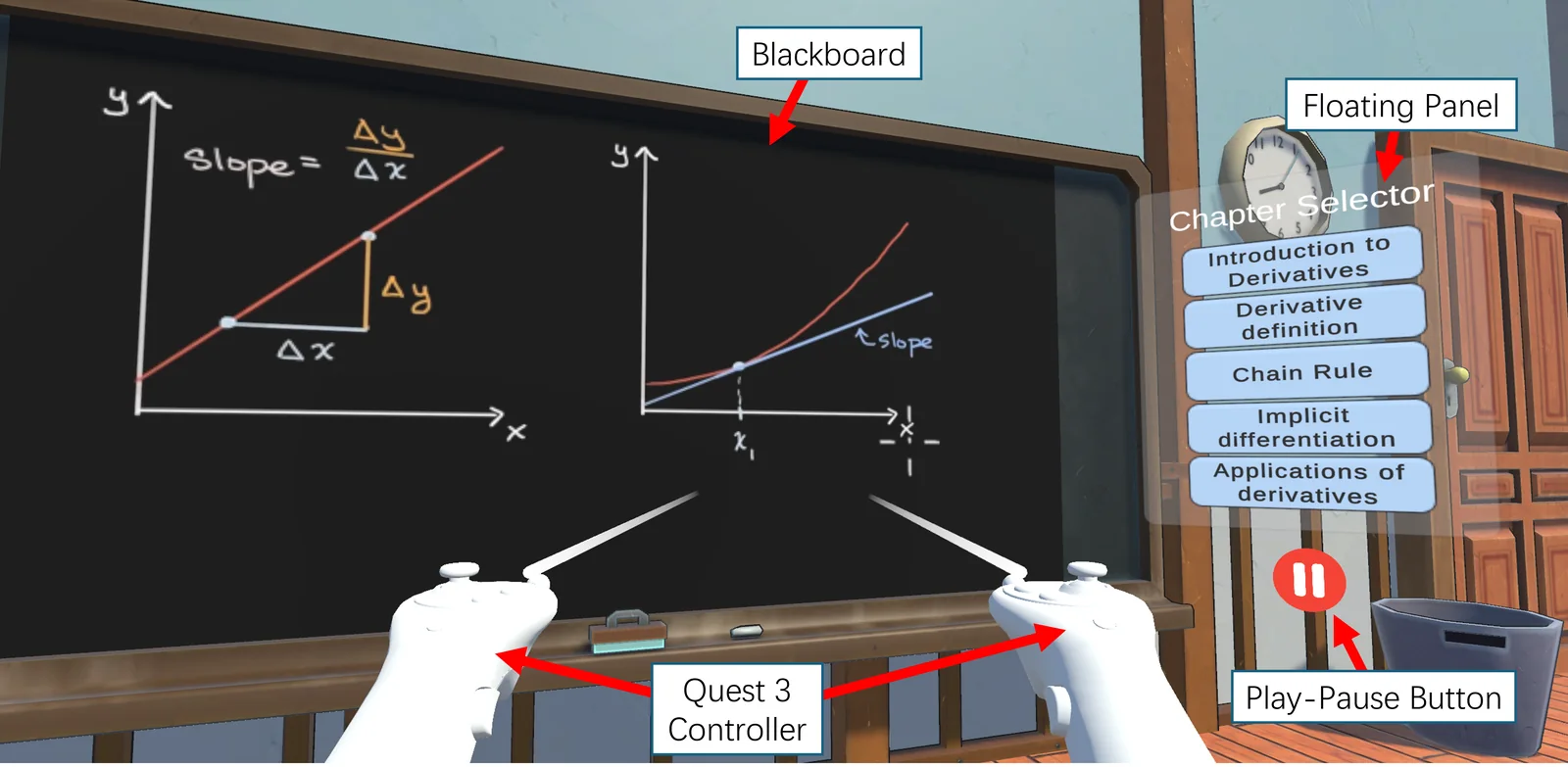
First-person view of the VR classroom, floating chapter selector, virtual blackboard, and Quest controllers

Virtual classroom

A chapter selector and virtual blackboard place existing calculus lessons in a focused spatial environment.
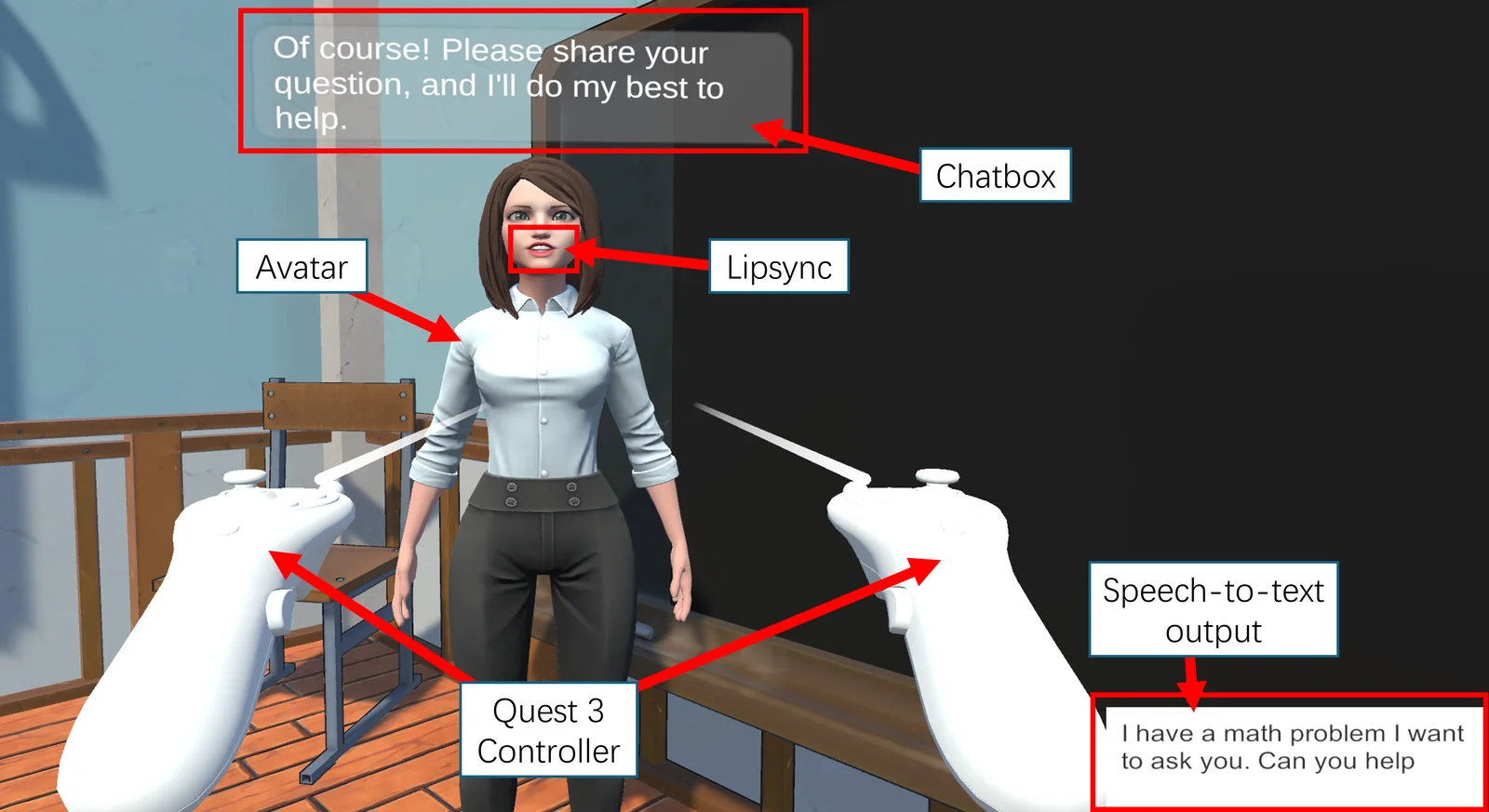
The embodied AI teaching assistant with labeled chatbox, lip-sync, Quest controller, and speech-to-text interaction

Embodied AI assistant

Speech recognition, text-to-speech, lip-sync, and avatar animation support a voice-first exchange.
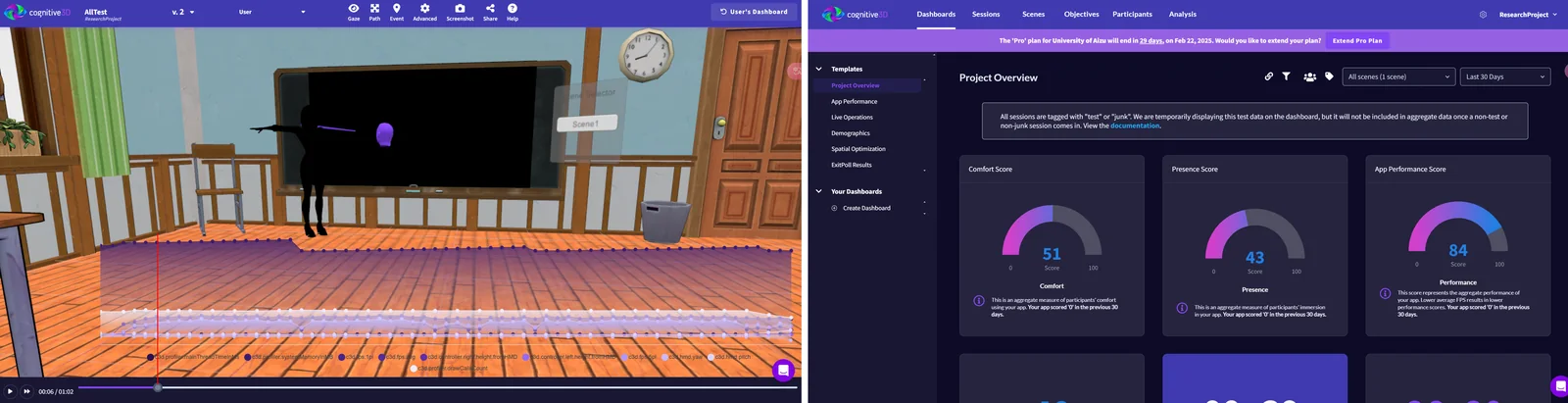
Cognitive 3D Scene Explorer replay and analytics dashboard used to review movement and engagement

Spatial analytics

Cognitive 3D records watch time, tutor interaction duration, movement, and replayable scene data for later study.

Authors

HuiShan LaiUniversity of Aizu
Alaeddin NassaniUniversity of Aizu
John BlakeUniversity of Aizu
Julián VillegasUniversity of Aizu

Citation

H. Lai, A. Nassani, J. Blake, and J. Villegas. “VR Math Bridge: Bridging Interactivity in Online Education with AI and VR.” In 2025 IEEE Gaming, Entertainment, and Media Conference (GEM), 2025. doi: 10.1109/GEM66882.2025.11155841.

@inproceedings{lai2025vr,
  author    = {Lai, HuiShan and Nassani, Alaeddin and
               Blake, John and Villegas, Julián},
  title     = {VR Math Bridge: Bridging Interactivity in Online
               Education with AI and VR},
  booktitle = {2025 IEEE Gaming, Entertainment, and Media Conference (GEM)},
  year      = {2025},
  pages     = {1--6},
  publisher = {IEEE},
  doi       = {10.1109/GEM66882.2025.11155841}
}